Publication

Savills U.S. Law Firm Activity Report Q2 2020

Image treatment
Q2 2020

The pandemic has disrupted nearly all industries, leaving organizations grappling with both economic and business uncertainty and shifting focus to cost reduction (including real estate costs), and placing many leasing decisions on a “pandemic pause.” Across all industries and markets, year-to-date total office leasing demand is down 30% when comparing the first half of 2019 to the first half of 2020. Volume declined 42% from Q1 to Q2 as many markets spent nearly a full quarter under lockdown restrictions.

The decline in leasing volume was even more pronounced in Central Business Districts (core downtown areas within each metropolitan region), where leasing declined 43% year over year and 52% from Q1 to Q2. Due to ongoing safety limitations on many businesses, industries hardest hit include those related to retail, entertainment and travel.

How have law firms been affected? Were legal tenants still willing to commit to real estate decisions in this period of uncertainty and, if so, why? Six months into the widespread dislocation caused by the COVID-19 pandemic, Savills Research teamed up with The Legal Tenant to study U.S. law firm leasing activity through the first half of 2020, tracking transactions over 20,000 square feet (sf) across key U.S. markets
Activity down, but not as impacted as other sectors

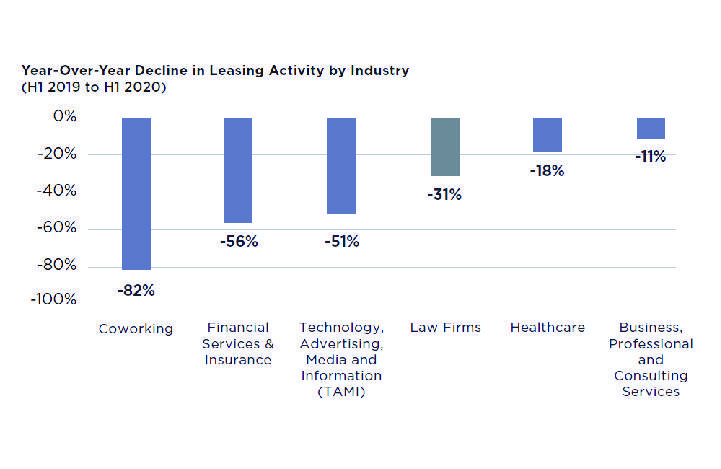
Law firms using over 20,000 sf leased a total of 2.7 million square feet (msf) across major markets in the first half of 2020, down 31% from the same period last year, with a 25% dip in activity from Q1 to Q2. Comparatively, leasing activity in the financial services sector declined 56%; the technology, advertising, media and information (TAMI) sector declined 51%; and coworking, one of the sectors most impacted by work-from-home measures, declined 82% year over year

Image treatment

One caveat to bear in mind—major transactions that have closed since the start of the pandemic have typically been in process for a significant time and were most often in the lease negotiation stage at the onset of the crisis. Anecdotally, it appears that fewer transactions are starting unless they have to (such as expiring leases), and many firms are considering short-term extensions rather than making long-term commitments while awaiting clarity on the full impacts of the COVID-19 crisis. In addition to economic and business uncertainty, law firms are also paralyzed by the future implications of operating with much of their workforce out of their offices. It has proven to be a challenge to move forward or start new transactions when the possibility of leasing less space is now an opportunity to decrease cost and increase profitability. In the interim, many firms are undergoing workplace strategy studies to help them determine how many lawyers and staff will return to the office, how often, and how their business environment might change in the future.

Demand varies greatly market by market, pandemic epicenters see sharper decline

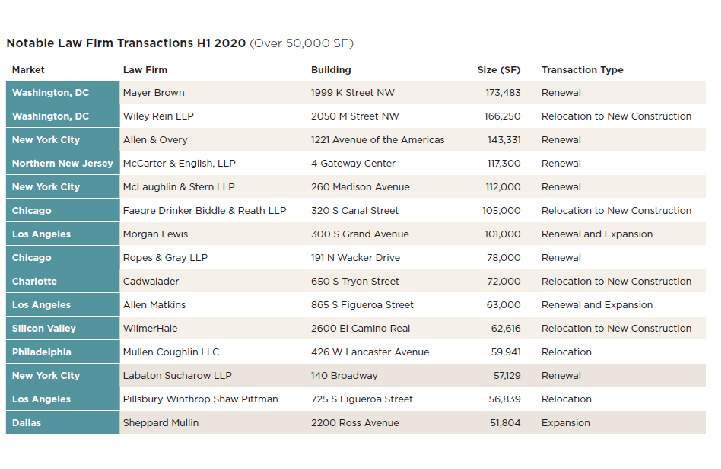
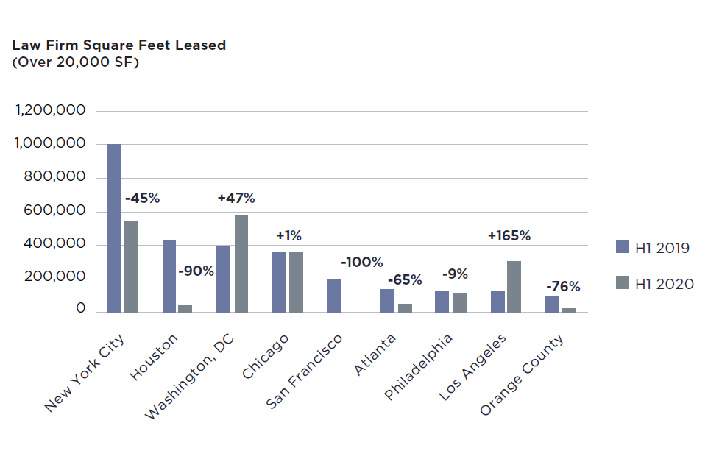
The decline in law firm leasing volume was not uniform across all markets. As one would expect, markets more impacted by the virus – those with higher caseloads and requiring more restrictive business closure measures – saw a greater decline. San Francisco and New York have shown signs of being more negatively impacted by current circumstances. In both cities, availability is on the rise, overall deal volume has declined significantly, and a flood of sublease space has hit the market. San Francisco saw no significant law firm leasing activity in 2020, and New York, which usually leads in law firm demand (by volume) saw a 45% decline from H1 2019 to H1 2020. New York saw just two law firm leases over 100,000 sf as Allen & Overy renewed 143,000 sf in Times Square on a short-term basis - canceling plans to relocate due to COVID-19 - and McLaughlin & Stern LLP renewed 112,000 sf in Grand Central. Houston, challenged significantly due to blows from both the COVID-19 crisis and oil and gas industry decline, saw a 90% drop in law firm leasing activity year over year.

Image treatment

In stark contrast, Washington, DC, has shown more signs of resiliency. Bolstered by activity from government and law firm sector tenants, DC saw a 47% increase in law firm leasing over the year. Two major transactions closed in 2020: Mayer Brown LLP renewed 173,000 sf in DC’s Central Business District (CBD) submarket and Wiley Rein consolidated from two adjoining buildings to 166,000 sf at a new trophy location, also in the CBD.

Los Angeles also saw a significant increase in law firm leasing volume into 2020 with three firms over 50,000 sf active. Two renewed and expanded in the market (Morgan Lewis and Allen Matkins) and Pillsbury Winthrop Shaw Pittman downsized and relocated.

Renewals, extensions and expansions outpace new leasing

With many organizations looking to push leasing decisions out until there is more economic clarity, renewals and extensions have increased in terms of share of activity. Law firm renewals, extensions and expansions within the same building accounted for 55% of activity so far this year. Law firms that are making a move are mostly looking for new buildings with abundant amenities and efficient floorplates. Of the six relocations over 50,000 sf signed this year, four were long-term commitments (10 years or more) in new developments. For the most part, renewals were long-term except for Allen & Overy in New York, which sought out a shorter term and extended for for five years, canceling plans to relocate at this time. The deals that closed in the first half of the year had been in progress for some time and it is possible that terms will become shorter more as more firms strategically delay or postpone leasing decisions over the coming quarters.

As markets continue to soften in the face of the pandemic downturn, there should be opportunities for tenants looking at both renewals and new leases – whether forced to make a decision due to lease expirations or seeking to capitalize on tenant favorability. Landlords are likely to offer more flexibility in renewals and extensions to keep tenants in place, as well as offer increasingly generous concession packages to secure tenants in relocations. Landlords have also shown flexibility by giving law firms more time to solidify their final square footage requirements, which is one of the main drivers behind the “pandemic pause” referenced above. Average tenant improvement allowances and months of free rent have increased across nearly all markets from Q1 to Q2. If law firms remain one of the more resilient sectors through the coming quarters, those firms that can make a real estate commitment in this downturn period are in an excellent position to capitalize on softer markets and more favorable terms.

Image treatment


Questions? Comments? Topic Suggestions?

Contact us


About the Legal Tenant Practice Group

Learn More