Halving the real estate expenses of a nationally ranked law firm while securing office-by-office buy-in for new office space standards is a tall order. Wilson Elser Managing Partner Robert Roarke steers the Am Law 200 firm’s Real Estate Strategy Committee. The Committee is developing a metrics-based process to determine how it will use office space more efficiently in the future. The effort is already paying dividends.
Establishing Goals & Metrics
Wilson Elser, founded in 1978 with a primary focus on the insurance industry, is aiming to reduce its real estate costs as a percentage of revenue to an industry-leading 5-7%. With nearly 800 attorneys in 35 offices nationwide, the firm has plenty of opportunities to maximize its real estate investment.
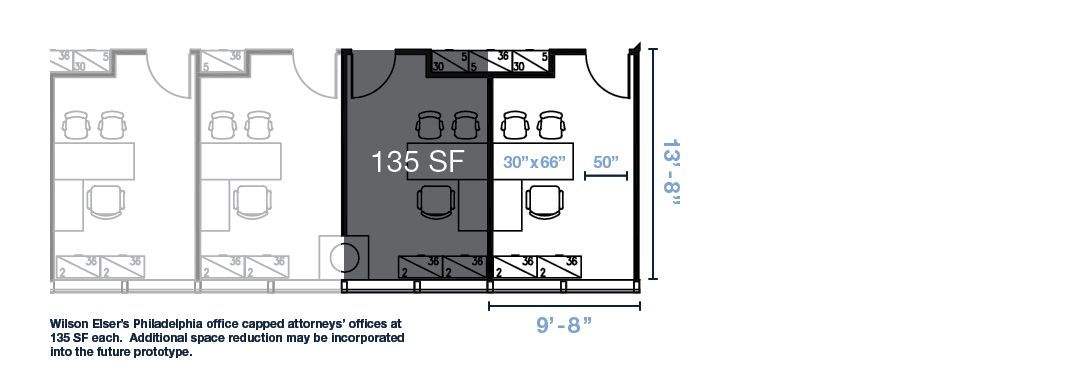
For starters, Roarke says, Wilson Elser has adopted a one-size-fits-all policy for attorneys’ offices, implemented whenever an office relocates or renegotiates a lease. The firm cut its space in Philadelphia by 40 percent by limiting offices for all partners and associates to 135 square feet, and has seen similar results in two other offices.
The committee’s biggest project so far is set to open early next year − a prototype office currently under development in Washington, DC. The new office will save money by occupying approximately half the space while serving the same number of attorneys and support staff. In addition to a number of dedicated offices averaging 120 square feet, the design also includes open, communal work areas with more-flexible, tech-connected workstations that feature soundproofing and privacy measures, such as computer screen confidentiality.
Embracing New Workplace Strategies
The space and cost savings come from a willingness to embrace fresh new workplace design features, such as:
- Flexible-function spaces replacing many dedicated offices
- Shared offices for select attorneys, especially those who spend less time in the office
- A partially open-office layout, with private and collaboration spaces available as needed
- A better technology platform to enable more telecommuting and remote working
- Sit-to-stand desks and more natural light to promote a healthier work environment
The new office prototype will not only save on space but, with cutting-edge design, concern for health and wellness factors, and a solid technology platform will also set the standard for future office design across the country.
Staying Flexible
Roarke acknowledged that the new model may be adjusted according to local market needs and culture as it rolls out to the rest of the offices nationwide.
“We are always looking for ways to create efficiencies,” Roarke says, noting that the firm outsources many of its administrative support services and has centralized its paralegal workforce in lower-cost space in the firm’s Milwaukee, Wisconsin, office. He anticipates that the firm will embrace the new office model and adapt to new ways of working as well.
For example, he occasionally works from a shared flex-space office near his home on Long Island rather than commuting to the firm’s New York City office. In higher-cost cities, the firm is reducing space in the city center while expanding in suburban office locations to reduce costs. In addition to its NYC office, the firm has offices in Stamford, Connecticut, and in Garden City and White Plains. Near Chicago, the firm has offices in Merrillville, Indiana, and Milwaukee, Wisconsin. Near St. Louis, the firm leased space in Edwardsville, Illinois, at $15/square foot versus $40/square foot.
Engaging the Next Generation
Roarke says that the firm realizes it needs to compete for new talent and keep younger associates engaged, so a big selling feature of the new design is improved profitability. In exchange for giving up the traditional carrot of increasing office size, partners and future partners know that they all have a stake in continued cost savings.
In creating the national Real Estate Strategy Committee, the firm deliberately chose more young partners than tenured ones to serve, because senior partners may resist giving up the larger offices they feel they’ve “earned.” And besides, Roarke points out, “the firm will be in the younger partners’ hands when this new model is fully realized.”
The key to the Committee’s success, observes the firm’s Savills Studley real estate adviser, Chris Tarzon, is that “the process is based on data, not emotions, and there is general agreement that the process is fair.” He adds, “There are firmwide standards, but it’s the metrics of the individual office performance, type of work, demographics and real estate market that drive the implementation – so the outcome is tailored to the location.”
The Committee developed a business “stress test” to calculate an individual office’s new dimensions as a percentage of that office’s revenue, in addition to other factors such as its historical and projected growth, the ages of partners and associates, the profitability and type of work performed – for example, research and writing that requires quiet and privacy or off-site work in court or with clients – before determining strategy.
Another key to Wilson Elser’s strategy is being open and honest with its real estate adviser – the firm doesn’t want cookie-cutter solutions. So, Tarzon makes sure he understands each office’s business dynamics. For example, how many partners are likely to retire over the next 10 years and whether business is expanding or contracting. That way, when he is negotiating a long-term lease, he can build flexibility into the lease, with terms such as expansion or contraction options and a termination option, at multiple points in the lease term.
The better the information Tarzon gets, the better tailored the solutions will be.
“We’ll see more partners coming around once they see how well flexible work schedules can accommodate various work styles,” Roarke says. “Younger associates need to be close to the nest while they’re learning, but senior attorneys can work effectively from home and be highly productive.” He anticipates the proposed workplace design will help foster new ways of collaborating and working more efficiently, taking the firm into a more profitable future.