
With more than €12,500 million invested in commercial real estate in H1 2018, the French investment market was up 27% – in contrast to a much more sluggish general European backdrop.
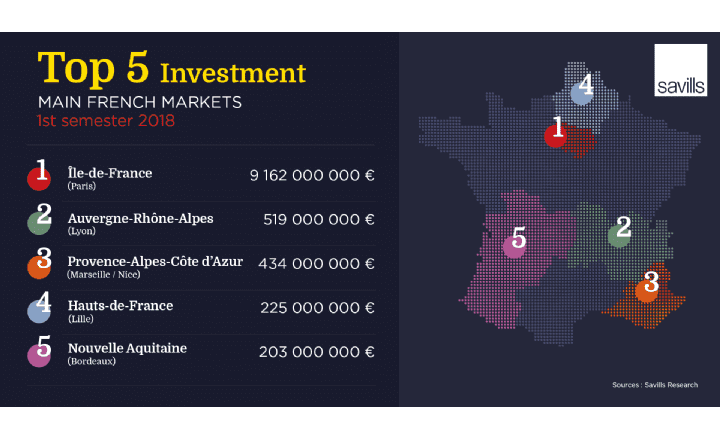
Ile-de-France is the main driver: the capital and its surrounding area account for 73% of the French market (almost €9,200 million) – investment volumes in Ile-de-France were up 61%. The Auvergne Rhone-Alpes region ranks in second place in terms of investment volumes, but represents less than 6% of the Ile-de-France market.
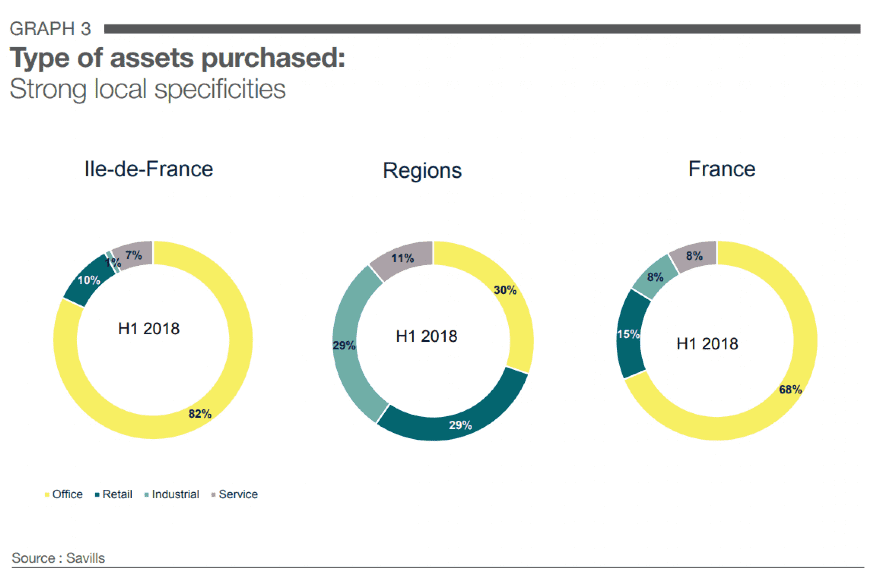
Offices account for 68% of commercial real estate investment. However, there are significant regional disparities – office market share reached 82% in Ile-de-France, but fell to 30% in the regions, where industrial and retail assets took over.
Core investments continued to dominate the market, although their market share has fallen sharply (from 91% of office investment volumes to 76% in one year). The rise of Core+ and Value Add assets is a clear sign of confidence in the French market. International funds are becoming more active in the market, with their investment volumes rising from 36% to 42% in France. The Ile-de-France region is still the main gateway to the French market for international investors.
Yields are tightening: although prime yields have gradually stabilised, 'secondary' yields have hardened due to the success of the Core+ and Value Add asset classes.
Prime yields have stabilised at record low levels. Real estate nevertheless continues to offer an advantage compared to bond yields: the spread stood at 235 basis points at the end of June 2018, above the tenyear average (199bp).
The French market is without doubt one of the strongest in Europe. However, it is not immune to global pressures
Boris Cappelle, Deputy Chief Executive, Investment Director
H1 2018: Cause for celebration
Performance is impressive – the French market has passed the halfway mark of 2018 up 27% y-o-y. Growth that was already visible at the beginning of the year, intensified in the second quarter.
More than €12,500 million was invested in comm ercial real estate in France in the past 6 months. This is 26% more than the average level observed over the last 5 years (€9,900 million on average for H1). Apart from 2016, a record year for investment volumes, it is the best performance on record.
The French market is certainly standing out, even more so thanks to the European context being much more subdued. Most of its neighbouring large markets have seen a fall in investment, from the UK (-9%), to Germany (-8%), to Italy (-29%) and Spain (-45%).
All indicators are pointing to a market with exceptionally good potential. It continues to rely on its well-established investments: the Core asset class remains active. After several years of domination, this asset class has nevertheless handed the reins over to Value Add and Opportunistic assets, which have led to this uplift. The latter assets, very popular among highly liquid Anglo-Saxon investors, are in full recovery.
.png "Image treatment")
On the lookout for opportunities
In such a sought-after market, investors are keeping their eyes trained on every opportunity. At the beginning of the year, several deals were closed in the regions, which increased their market share of the investment volume in France.
Most definitely a trend, but one we identified as provisional, as it was likely to be impacted by the completion of some large deals in Ile-de-France. This was indeed what happened during Q2 2018, which saw a renewed concentration of the French market in the Parisian region. In 3 months, 9 transactions of over €200 million each were completed in Ile-de-France, while only one was recorded in the regions.
Over the whole of H1 2018, almost €9,200 million was invested in Ile-de-France, 73% of the whole French market. Investment volumes in Ile-deFrance rose sharply y-o-y (+61%).
In contrast, regional markets saw investment fall (-20%); not because they are no longer of interest to investors, but this time around they did not benefit from a "new" Logicor portfolio, the sale of which in June 2017 for more than €1,500 million had a major impact. Due to their relative limited scope, regional markets are dependent on a finite number of large deals, and are therefore structurally volatile.
H1 2018 also saw significant growth in retail investments (+74%), and, particularly, in alternative real estate (+136%). At the beginning of the year, the retail segment benefitted from the sale of 114 Champs-Elysées for €600 million; as is the case for regional markets, this segment is dependent on the completion of a limited number of large deals, and is therefore likely to see marked fluctuations in activity.
On the other hand, the growth of the alternative real estate segment, seems to be more of an underlying trend, in that it is based on an increasing number of medium-sized transactions, mainly for properties under development.
The growth of these segments notwithstanding, offices continued to dominate the market with a +41% rise, representing 68% of investment volume in France over H1 2018. In fact, the industrial asset class was the only segment to shrink, (-55%) – an inevitable drop, given that 2017 figures were buoyed by the Logicor mega deal.
Parallel strategies
As a result of the rapid increase in activity in large and very large transactions during Q2 2018, the share of Core assets rose, whereas it had fallen sharply at the start of the year.
The lion's share of sales over €200 million related to secured assets. This phenomenon was boosted by the return of German investors to the French market – which were behind 4 of 11 Core deals for more than €200 million completed since the beginning of the year.
Nevertheless, the share of secure assets was down over the whole of H1 2018, falling from almost 91% to 76% of investment volumes in France in one year. Attracted by France's stability and probusiness orientation, and confident in the resilience of the lettings market, particularly in the Parisian region, with its strong transactional activity, very low vacancy rates and rents which are rising faster than inflation, investors are prepared to accept a higher level of risk.
Pan European Core+ and Value Add funds are driving this trend, after deciding to actively increase the share of French assets in their portfolios. This is particularly the case for Anglo-Saxon investors, who have considerable financial strength.
Open to international business
The marked increase in interest in the French market from international investors is clear for all to see. This is demonstrated by their share of investment volumes, which rose from 36% to 42% nationally in one year. Ile-de-France is logically the main gateway to the French market, and is the most international market in France.
French investors still represent the majority, but their market share fell significantly, particularly because investment funds were more cautious, due to the fall in real estate fund-raising – a direct result of the introduction of the IFI (French property wealth tax), in place of the ISF (French wealth tax). This decline may only be temporary, as fund-raising seems to have risen again since May this year. Nonetheless, although French investors have monopolised the national market for a decade, they have started to see increased competition from German investors, who have made a notable comeback (rising from under 8% to 14% of investment volumes in one year), in addition to British funds (from 3 to 10%), and US funds (from 2% to 8%).
Asian investors' market share is in sharp decline, although this is primarily due to their over-representation in H1 2017, following China Investment Corp's acquisition of the Logicor portfolio, in addition to increasingly strict regulation concerning capital exiting China. The coming months should see this reduction partially compensated by an expected upturn in Korean fund activity, and by likely renewed interest from Middle Eastern investors, encouraged by rising oil prices.
Redefined entry conditions
Investor interest in all the opportunities the French market has to offer, whether Value add assets, alternative assets, emerging Parisian or regional markets, is gradually affecting yields.
Prime yields in the Core segment gradually stabilised in Q2 2018, which have plateaued at very low levels. At 3.0% for Core CBD office assets, the market is at a record low.
Such levels still offer a yield advantage for real estate - the spread with bond yields stood at 235 base points at the end of June 2018, well above the ten-year average (199bp). However, Core investors are currently looking for security and are not prepared to accept further prime real estate yield compression. They prefer to play it safe when confronted with an unstable economic and global backdrop.
In the Core+ and Value Add segments, the tone is different. The positioning of international funds in the French market, with aggressive strategies and strong financial capabilities, has caused the yield spread between high risk and non-risk assets to narrow. This is all the more pronounced as investors see significant growth potential in the French market, allowing them to anticipate higher future property revenues. In fact, tightening yields are the defining characteristic of the French market at this mid-point in the year.
Outlook
■ The economy is showing signs of growing uncertainty. While the European Central Bank confirmed in June that the quantitative easing tap would be turned off by the end of the year, the trend in its key lending rate is once again becoming a key factor. An increase in this rate, primarily requested by the Bundesbank, has been factored in by investors, but the slightest indication as to the date or the amount of the increase is eagerly anticipated. In an effort to alleviate these concerns, the ECB recently announced that it would like to keep interest rates low, at least until summer 2019.
■ In France, as in the wider Eurozone, economic growth slowed in the first half of 2018. Even though economic growth should pick up again in the second half of the year, most analysts agree on 1.8% GDP growth in France in 2018 (compared to 2.3% in 2017).
■ This climate of uncertainty could lead to longer transaction completion times, linked to stricter requirements from purchasers in terms of regulatory, legal and financial guarantees. The resilience of the lettings market, as currently observed, will be essential in easing emerging concerns and in encouraging investors to continue their ambitious strategies.
■ Fund-raising by investment funds dropped sharply, as a result of the introduction of the IFI (French property wealth tax). These players, who for several years have played a key role in the French market, now have less room to manoeuvre. The market is like nature, it "abhors a vacuum". The absence of investment funds has therefore been compensated for by the arrival of new investors, particularly from abroad, but this situation leaves the French market open to greater dependence on international deals. An increase in fund-raising, which seems to have been the case since May 2018, bodes well, but is yet to be confirmed.
■ It is therefore not clear whether the French investment market can sustain the same level of activity over H2 2018. Progress made in the first six months of the year, and the strong possibilities linked to the number of deals under negotiation, would suggest an annual investment volume slightly above that observed in 2017, reaching between €25,000- 27,000 million.
■ The wide spread with bond yields is currently compensating for the growing uncertainty around the monetary environment: stabilising prime yields across the board is the most likely hypothesis from now until the end of 2018. Net initial real estate yields could continue to tighten, at least in the main markets in the Paris region.