Moreover, the large-scale transactions segment, volatile by nature, is poised for a wave of prominent signings (e.g. such as the space leased by CNP Assurance), while certain transactions agreed over the last few months have yet to be recorded. These include a lease for over 5,600 sqm in Paris Centre West that was signed by one of the ‘Big Four’ tech companies and several deals struck with co-working operators.
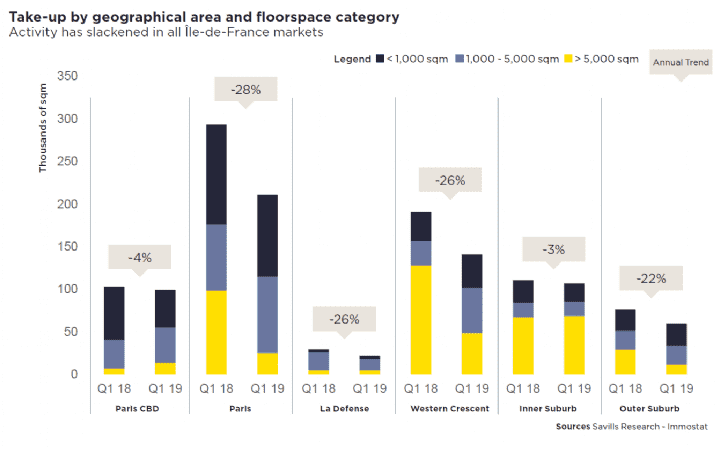
There’s been a general easing off across the entire Île-de-France region, but the pattern is not geographically uniform. At one extreme, activity in Paris’s Inner Suburbs is down just 3%; while at the other, central Paris has seen the quarter’s sharpest drop, at 28%. Although the city centre still dominates the market, its share of total transaction activity has fallen from 42% in Q1 2018 to 39% in the same period of 2019. Occupiers are switching their allegiance to more outlying areas, starting with the Inner Suburbs, which are benefitting from the displacement of demand from central Paris and rising rents.
With less than 23,000 sqm let in three months, the La Défense market has also cooled significantly (down 26% y-o-y) and is still performing below its potential. Just one transaction involving floorspace in excess of 5,000 sqm was recorded this quarter, a disappointing result for a business district that has always been popular with major occupiers.
Take-up is also down 26% in the Western Crescent, which enjoyed a sizeable uplift from major transactions in 2018.
Available supply: Still shrinking
At a total of 2.9 million sqm across Île-de-France, immediate supply is still dwindling (down 7% y-o-y). Vacancy rates are low throughout the region, with the average currently standing at 5.4% (down from 5.8% in Q1 2018).
Undersupply is starting to stifle the Île-de-France lettings market, with certain areas more conspicuously affected. In central Paris, the immediately available stock is barely enough to satisfy five months of demand. The vacancy rate in this zone is just 2.3%, slumping to as low as 1.5% in the Central Business District. Also suffering from a contraction in available space are La Défense (down 26% y-o-y) and the Western Crescent (down 12% y-o-y). In the Inner and Outer Suburbs, this trend is less pronounced.
While still struggling with a quantitative shortfall, the issue of quality is no longer quite so pressing. The supply of Grade A properties, often occupiers’ first choice due to their efficiency and practicality, is expanding. At the end of Q1 2019, a total of 545,000 sqm of Grade A space was available to let, representing 19% of immediate supply. This influx of higher quality stock, redressing a deficit that was dampening activity, is due to a greater volume of new-build or refurbished space entering the market (1,075,000 sqm has been delivered since this time last year, compared with 830,000 sqm in the preceding 12-month period). Over the next few months, the situation should continue to improve, with 1,010,000 sqm of fresh supply already in the pipeline and due for delivery by the end of March 2020 – even though 54% has already been pre-let (60% if we just include deliveries expected by the end of 2019).
Rent: Inflationary forces still at work
Continued strong demand for office space combined with diminishing supply is a sure-fire recipe for upward pressure on rental prices. Rents have been rising steadily since 2017 and are not levelling off just yet. However, a number of shifts can be observed. Following steep rental growth for Grade A space in the most highly prized or well-established locations, the pace is now slowing. Rents have even started to dip in the La Défense market, where the dearth of prime property means that this segment is no longer pushing up the cost of new-build or refurbished space. The flip side to this is that Grade A workspace in neighbouring markets is becoming more expensive, as long as good public transport links are available. This is the typical pattern in various parts of the Western Crescent and the East and South Inner Suburbs.
The view from the existing property segment is quite different. Here, signing rents had been taking longer to adjust but are now catching up to some extent, at least in the most sought after markets. Throughout central Paris, average rents for existing property are now on the rise (the 3rd, 4th, 10th and 11th arrondissements, for example, have seen rents soar by 22% y-o-y). Even La Défense has been lifted by the tide, with a 2% bump in the average rent for existing property, pushing €450 at the end of Q1 2019.
(1).jpg "Image treatment")
.png "Image treatment")
.png "Image treatment")