Sit back and wait or more of the same?
The end of 2019 brought a marked slowdown in the French economy. Was this a temporary wobble, an artefact of shifting market conditions, or a long-term readjustment for France, which has shown such remarkable resilience compared to other major economies? For a whole host of reasons, the former seems more likely. France still has one ace up its sleeve in this volatile and uncertain international climate: reliability.
It was a distinctly chilly wind that blew through the French economy in the fourth quarter of 2019. After ticking over at a growth rate of 0.3–0.4% since the start of the year, GDP dipped slightly in Q4, down 0.1% on Q3. This was a disappointing result, and one that economists failed to predict. There were various contextual factors behind this unwelcome surprise, starting with the protracted strike in protest against France’s proposed pensions reform. A substantial proportion of railway, local transport and port workers took part in the strike, particularly affecting public and freight transport. The lower rate of growth in household spending observed during the crucial Christmas period (up just 0.2% in Q4) can largely be attributed to strike activity, as can the sluggish growth in business investment (up 0.3%).
Overall, this rocky spell dragged France’s economic growth for 2019 down to 1.2%. This is lower than anticipated — forecasts from various respected sources had led us to expect a growth rate of between 1.3% and 1.4%. It puts France broadly back on a level with the United Kingdom or with the Eurozone as a whole. This means that the dent in international trade caused by tensions between the US and China has been less of an issue for the French economy, which remains primarily driven by domestic demand, whether in the form of household consumption or corporate investment.
Altogether, these factors have led forecasters to expect growth of between 1.1% and 1.3% for France in 2020. This is perfectly consistent with the country’s 2019 performance: slow, steady, free of major upsets... and ultimately rather reassuring.
The Île-de-France lettings market
A sprint finish, but not quite enough
There was a distinct upturn in transaction activity over Q4 2019, but it was a case of too little, too late. Take-up in this quarter was fairly high at 640,000 sqm, but this could not quite make up for a lacklustre start to the year. The lettings market suffered a slight contraction compared to 2018, falling back in line with the ten-year average.

Take-up: an overall slowdown, but the situation calls for some perspective
The lettings market was playing catch-up in Q4 2019, having spent the first nine months of the year in the doldrums. Alas, this sprint finish was not quite enough to close the gap. Overall, Île-de-France posted a take-up of nearly 2,320,000 sqm over the course of the year, a 10% slump when measured against a superb 2018 and its impressive 2,500,000 sqm.
Take-up was pulled down mainly by a 14% drop in the large transactions segment (i.e. deals involving space of 5,000 sqm or more). To be fair, this segment of the market spent 2018 on such a high that a readjustment was almost inevitable.
Although activity picked up over the last few months of 2019, major occupiers took a step back, accounting for fewer transactions (73 completed deals, down from 83 in 2018) and a lower level of take-up — barely reaching 873,000 sqm, compared with 1,010,000 sqm in 2018.
This pattern was especially marked towards the upper end of the spectrum, where a fall in the number of large deals exerted the greatest drag on the overall figures. The year’s largest transaction involved a space of just over 40,000 sqm (a complex in the Issy Cœur de Ville redevelopment district, sold to owner occupier CNP Assurances). In contrast, in 2017 and 2018 there were several recorded lettings involving properties of over 50,000 sqm.
There are various reasons for this shift, a key consideration being the shortage of immediate supply, which has become particularly acute in certain parts of the Paris region. In turn, this has driven up asking rents and encouraged landlords to cut back on incentives. Just as circumstances were conspiring to make occupiers more cautious, many of them (those whose current lease agreements were signed between five and nine years ago) were also approaching the point of renegotiating terms, having secured starting rents that seem on the low side today. In light of the prevailing market conditions, many opted to renegotiate their current lease rather than cast around for an alternative.
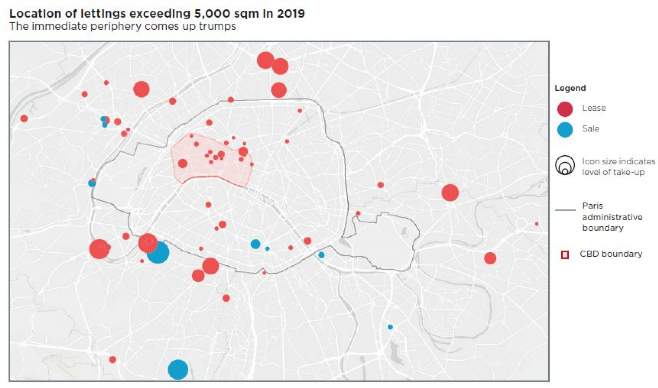
From our discussion thus far, 2019 may look like a disappointing year, but don’t be deceived — nothing is quite that simple. First of all, we need to bear in mind that 2019 marked a return to a level of activity close to the ten-year average (2.3 million sqm). In this respect, then, it cannot accurately be said that the markets “underperformed”. Second, if we look at some of the other floorspace segments, it becomes clear that the lettings market has actually developed greater resilience over the last 12 months.
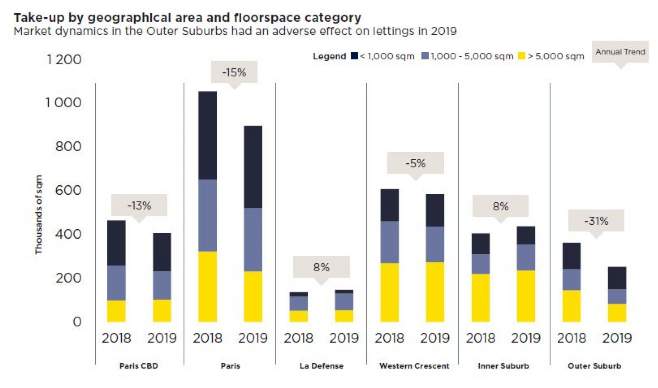
Transactions in the <5,000 sqm segment generated a take-up of over 1.4 million sqm, which is high by historical standards. This is despite the scarcity of supply in what many small and medium-sized occupiers would regard as the most sought-after locations (i.e. central Paris) and the growing popularity of co-working spaces and similar solutions. The small transactions segment (i.e. floorspace of less than 1,000 sqm) fared better in 2019, although activity dropped in this part of the market as well, with a year-on-year decline of 7%. This remains a key segment of the market, accounting for 31% of take-up in the Île-de-France region as a whole. That’s exactly the same percentage represented by mid-range transactions (between 1,000 sqm and 5,000 sqm), although a moderate decline (8% year-on-year) was also observed here.
So, while perhaps not one for the record books, 2019 can be chalked up as a respectable and well-balanced year - a consolidation phase for the Île-de-France market.
It is also worth noting that the lettings market in the Paris region has retained one of its most characteristic features, and a mark of its solidity: an extremely diverse range of profiles among the occupiers driving transaction activity. Take the large transactions segment, for instance: while the banking, finance and insurance sectors are still in pole position, they now represent just 21% of take-up. Hot on their heels are co-working operators (on 11%), companies in the IT and communications sector (10%) and public or quasi-public bodies (7%).
Geographically speaking, transaction activity in Île-de-France is still ruled by the quest for that holiest of grails, centrality - or, failing that, easy access to the main business districts via fast, high-quality transport links. This drive for centrality is the obvious culprit behind the less inspired performance of, say, the Outer Suburbs, where take-up fell sharply in 2019 to the tune of 31% year-on-year. For entirely different reasons, activity also took a hit in Central Paris, with this area posting a year-on-year drop of 15%. Here, there is a glaring supply problem that has put a damper on the market. With very little to be found in the way of immediate supply, occupiers have been left no choice but to resort to pre-lets or find alternative solutions to their space requirements (postponing their decisions, renegotiating existing leases, seeking out other viable locations, exploring co-working options, etc.). Still, Central Paris’s loss is La Défense’s gain: here, activity is up 8% and things are looking unusually sprightly in the small and medium-size office segment, customarily quieter than in more central areas. This geographical shift has benefited the Inner Suburbs as well, also up 8% thanks primarily to the remarkable performance of the Northern Inner Rim, where activity spiked by a remarkable 79%. The situation is somewhat less spectacular in the Western Crescent, down 5% despite the buoyancy of the South End submarket, which is up 48%.
Immediate supply: Get in quick
Quarter after quarter, in 2019 Île-de-France remained stuck in a pattern that seems to have become the norm: a persistent scarcity of immediate supply.
Overall, 2.7 million sqm of office space was available for immediate occupation at the end of 2019, marking a year-on-year contraction of 8%.
Another big problem on the supply side is the fact that much of the available stock is sorely in need of some degree of upgrading, and has been for several years. True, the amount of Grade A space is proportionally slightly greater, having grown from 18% to 20% of all available stock over the course of 2019. However, this is only a fraction of what is needed to meet demand. Compare the percentage of Grade A supply to what we know about demand: in 2019, 69% of all spaces let in major deals were in new-build or refurbished properties.
While the situation is by no means uniform, the downward trend in immediate supply is now evident across all major markets in Île-de-France. The average vacancy rate for the region stands at 5%, no longer sufficient to ensure optimum fluidity in the lettings market. Clearly, there are certain areas that are now facing a situation of undersupply. This is certainly the case in Paris, where there is barely three months’ worth of available stock . This is putting real pressure on rental values, as we can see from the spiralling prime rent in the CBD: €850 per sqm per year and mounting.
The contraction in immediate supply can also be observed in the La Défense business district, where the vacancy rate is just about holding at 4.5%, within touching distance of its historic low. A number of new developments are due to come onto the market in this area over the next couple of years, amounting to a total of around 333,000 sqm. This should help ease the pressure on supply, especially as none of these projects have yet reached the pre-letting stage.
With an overall vacancy rate of 10%, the Western Crescent is something of a regional outlier. There are generally more options to be found here than in neighbouring markets, and the quality tends to be higher: 28% of the immediate supply is classed as Grade A space. With space at a premium across the board, the Western Crescent is sitting on a potential treasure trove. Bear in mind, however, that this area is made up of a patchwork of submarkets with very varied profiles.
Most vacant stock (61%, in fact) is concentrated in Péri-Défense, pushing the vacancy rate in this district up to 17%. At the other end of the spectrum, the vacancy rate in neighbouring Neuilly-Levallois has fallen to 3.4%.
In the Inner Suburbs, take-up soared in 2019, leading to a fairly pronounced drop in supply (down 18% year-on-year) that is now spreading to every submarket. Just one is currently bucking the trend: with a vacancy rate of 10%, the North Inner Suburb has the most abundant supply in this area; more than half of all available space is concentrated here. The East and South Inner Suburbs have far less to spare, with vacancy rates of just 2.7% and 4.8%, respectively.
The Outer Suburbs had a disappointing year in the lettings market in 2019, and as a result have suffered less severe immediate supply problems than other areas, posting a year-on-year drop of 5%. The South Outer Suburb — which thanks to the town of Massy in particular holds a good proportion of the region’s available stock and new-build space — has more to offer than any other location in this tier. Here, the vacancy rate is close to 11%.